ES EspañolEN English
Skip to content
Sergio DolzTRAIN
PregnancyBeginnerFree routine

Pregnancy at home · comfortable strength

Ten adaptable movements for an uncomplicated pregnancy, after reviewing activity with your midwife or obstetrician. Split the session if needed and use the range and supports that are comfortable today.

Read the workout without signing up. The app adds a timer, set logging and access to your activity.

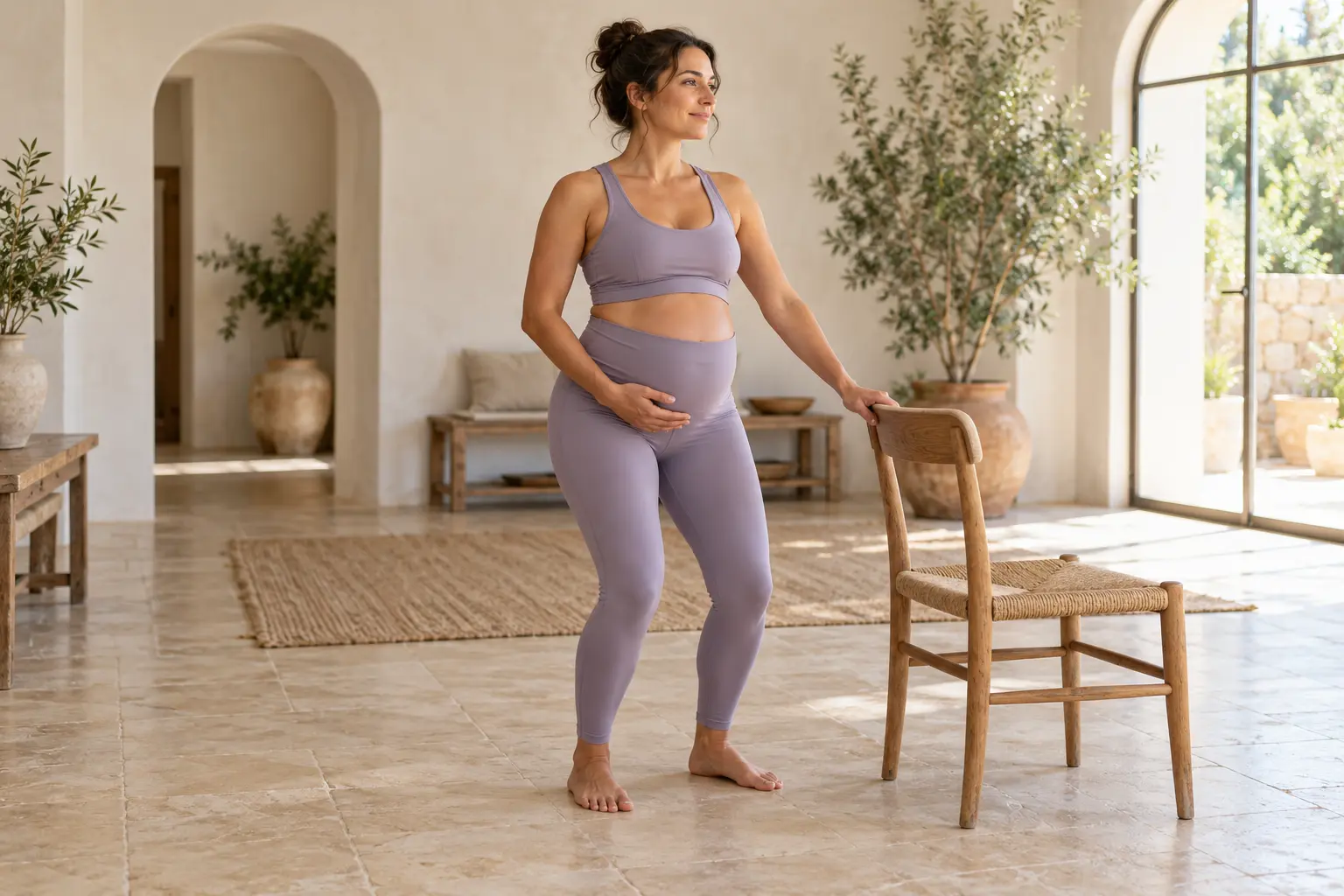
A pregnant woman in a gentle supported-movement scene. AI-generated image.
INDIVIDUAL ADAPTATION

Pregnancy · movement with support

Educational options for an uncomplicated pregnancy, after checking with your midwife or obstetrician what activity you can do. The “Beginner” level describes the movement; it does not confirm suitability for your pregnancy.

Before you begin. If you have a complication, an obstetric restriction, pelvic pain or difficulty controlling your pelvic floor, request an individual adaptation before using these sessions. They are not a postnatal recovery programme.

Effort. You should be able to talk comfortably. Reduce repetitions or duration depending on the day, breathe during exertion and avoid exhaustion. The aim is not muscular failure.

Adaptations and sources
  • First trimester: adjust rests to nausea and tiredness; do not try to make up missed sessions.
  • Second and third trimesters: adapt your range and supports to your growing abdomen and balance. Avoid remaining flat on your back, particularly from week 16.
  • Avoid excessive heat, contact impacts and activities with a risk of falling. If supporting yourself on one leg causes pelvic pain, stop that activity.
  • Pelvic floor: being able to release between contractions matters. If it hurts or you cannot relax, consult a pelvic floor physiotherapist.

When to stop. Stop exercising and seek medical attention for vaginal bleeding, fluid leakage, regular painful contractions, chest pain, fainting or unusual breathlessness. Do not restart until you receive guidance. Also seek advice for a severe headache, vision changes, pain or swelling in one calf, or a decrease in your baby's usual movements. For severe symptoms or an emergency, call 112.

Approximate duration
25 min
Level
Beginner
Session
10 exercises
Demonstrations
10 with video

Prepare your workout

Equipment
Stable chair, Wall and Light resistance band; Mat for hands-and-knees movements
Before you choose
Read the pregnancy guidance before starting. Reduce or avoid single-leg support if it causes pelvic pain; do not train with warning symptoms.
Intensity
Comfortable conversation, breaks as needed and breathing during effort. Do not aim for muscular failure.
Warm-up
Preparation is already included at the start: Shoulder circles · pregnancy; Seated ankle mobility · pregnancy. Follow those blocks as prescribed and do not repeat them as extra work. Start with today's comfortable range and any breaks you need; you may stop here if this is enough.

Duration is approximate. Prepare your equipment and take the indicated rests; needing more rest can make the workout longer.

PREPARE TO MOVE

Your warm-up

These movements are already part of the workout. Do them in their scheduled place rather than repeating them as extra work.

  1. Shoulder circles · pregnancy

    1 × 6

    Sit or stand comfortably with relaxed arms. Make small, slow shoulder circles backwards. Reverse into forward circles without moving your head.

    What you train: Mobilises the shoulders and upper back without load.

    Watch video See its place in the workout
  2. Seated ankle mobility · pregnancy

    1 × 6

    Sit on a firm chair and slightly extend one leg with its foot off the floor. Draw your toes towards you without moving your knee. Gently point them away and repeat with the other ankle.

    What you train: Moves the ankle up and down without bodyweight loading.

    Watch video See its place in the workout
STEP BY STEP

Your complete workout

10 exercises
  1. Shoulder circles · pregnancy

    Adapted movement

    1 × 6

    How to do it
    1. Sit or stand comfortably with relaxed arms.
    2. Make small, slow shoulder circles backwards.
    3. Reverse into forward circles without moving your head.

    What it trainsMobilises the shoulders and upper back without load.

    Rest
    Rest 30 s or longer until control returns.
    Tempo
    Controlled, without holding your breath
    The movement, step by step

    Sitting or standing, let your arms relax. Make small, slow circles with your shoulders backwards, then forwards.

    Technique cueRelax your neck and breathe during the movement.

    Watch the demonstration for Shoulder circles · pregnancyBromley Healthcare · English · Opens a new tab
    Source and verificationOpen the original source

    Technical reference from the stated source. YouTube metadata (title, channel and offered player) checked on 2026-10-01. This check does not certify full playback.

    Date checked:

    General movement demonstration. This adapted card's posture, prescription and limits take priority; the video does not establish clinical suitability.

    Variations and mistakes to avoid
    More accessible
    Reduce the range and repetitions. Keep your supports; if the movement is still uncomfortable, leave it out and ask for another option.
    To progress
    Only after confirming good tolerance with your professional, add one or two repetitions. Do not increase duration, load and difficulty at the same time.
    Avoid this mistake
    Moving abruptly or tensing your neck.
    View exercise guide
  2. Seated ankle mobility · pregnancy

    Adapted movement

    1 × 6

    How to do it
    1. Sit on a firm chair and slightly extend one leg with its foot off the floor.
    2. Draw your toes towards you without moving your knee.
    3. Gently point them away and repeat with the other ankle.

    What it trainsMoves the ankle up and down without bodyweight loading.

    Rest
    Rest 30 s or longer until control returns.
    Tempo
    Controlled, without holding your breath
    The movement, step by step

    Sit with one leg slightly extended and your foot off the floor. Point your toes towards you, then gently away. Switch sides.

    Technique cueMove only the ankle within a comfortable range.

    Watch the demonstration for Seated ankle mobility · pregnancyBromley Healthcare · English · Opens a new tab
    Source and verificationOpen the original source

    Technical reference from the stated source. YouTube metadata (title, channel and offered player) checked on 2026-10-01. This check does not certify full playback.

    Date checked:

    General movement demonstration. This adapted card's posture, prescription and limits take priority; the video does not establish clinical suitability.

    Variations and mistakes to avoid
    More accessible
    Reduce the range and repetitions. Keep your supports; if the movement is still uncomfortable, leave it out and ask for another option.
    To progress
    Only after confirming good tolerance with your professional, add one or two repetitions. Do not increase duration, load and difficulty at the same time.
    Avoid this mistake
    Moving your foot with momentum or pushing into a painful range.
    View exercise guide
  3. Sit to stand · pregnancy

    Adapted movement

    1 × 6

    How to do it
    1. Sit on a firm, non-wheeled chair with both feet grounded.
    2. Lean slightly from your hips and push through the floor to stand.
    3. Move your hips back and sit slowly without dropping.

    What it trainsWorks the legs and glutes for controlled standing and sitting.

    Rest
    Rest 30 s or longer until control returns.
    Tempo
    Controlled, without holding your breath
    The movement, step by step

    Sit on a sturdy chair without wheels, with your feet on the floor. Lean forwards slightly from the hips, stand up and slowly sit back down.

    Technique cueFix the chair against a wall and keep feet grounded.

    Watch the demonstration for Sit to stand · pregnancyUCLH · NHS · English · Opens a new tab
    Source and verificationOpen the original source

    Official page link and title checked; full playback unverified. YouTube metadata (title, channel and offered player) checked on 2026-10-01. This check does not certify full playback.

    Date checked:

    Pregnancy demonstration. Adjust seat height and use assistance when needed.

    Variations and mistakes to avoid
    More accessible
    Reduce the range and repetitions. Keep your supports; if the movement is still uncomfortable, leave it out and ask for another option.
    To progress
    Only after confirming good tolerance with your professional, add one or two repetitions. Do not increase duration, load and difficulty at the same time.
    Avoid this mistake
    Dropping onto the seat or losing contact between your feet and the floor.
    View exercise guide
  4. Wall push-up · pregnancy

    Adapted movement

    1 × 6

    How to do it
    1. Face the wall, hands at chest height and feet slightly apart.
    2. Bend elbows and move your whole body towards the wall without sagging.
    3. Push back, keeping head and trunk aligned.

    What it trainsWorks chest, triceps and shoulders with wall support.

    Rest
    Rest 30 s or longer until control returns.
    Tempo
    Controlled, without holding your breath
    The movement, step by step

    Place your hands at chest height. Bend your elbows to move towards the wall, then push back to the start.

    Technique cueMove your body as one unit rather than just your head.

    Watch the demonstration for Wall push-up · pregnancyBESS - British Elbow & Shoulder Society · English · Opens a new tab
    Source and verificationOpen the original source

    Technical reference from the stated source. YouTube metadata (title, channel and offered player) checked on 2026-10-01. This check does not certify full playback.

    Date checked:

    General movement demonstration. This adapted card's posture, prescription and limits take priority; the video does not establish clinical suitability.

    Variations and mistakes to avoid
    More accessible
    Reduce the range and repetitions. Keep your supports; if the movement is still uncomfortable, leave it out and ask for another option.
    To progress
    Only after confirming good tolerance with your professional, add one or two repetitions. Do not increase duration, load and difficulty at the same time.
    Avoid this mistake
    Letting your waist sag or moving only your head forwards.
    View exercise guide
  5. Chair resistance-band row · pregnancy

    Adapted movement

    1 × 6

    How to do it
    1. Sit on a firm chair with a light band secured beneath both grounded feet.
    2. Hold the ends and draw elbows back as you breathe out.
    3. Straighten arms slowly without letting the band pull you forward.

    What it trainsWorks the back and arms during the pull and controlled return.

    Rest
    Rest 30 s or longer until control returns.
    Tempo
    Controlled, without holding your breath
    The movement, step by step

    Sit on a sturdy chair with your feet supported and a light band under both feet. Draw your elbows back without shrugging your shoulders. Return with control and breathe out as you pull. Check that the band cannot slip free.

    Technique cueEnsure the band cannot slip free and keep it away from your face.

    Watch the demonstration for Chair resistance-band row · pregnancyRoyal United Hospitals Bath · NHS · English · Opens a new tab
    Source and verificationOpen the original source

    Link published in the official obstetric physiotherapy document; full playback not checked. YouTube metadata (title, channel and offered player) checked on 2026-10-01. This check does not certify full playback.

    Date checked:

    Obstetric reference using a band and chair. You may also rehearse the curl without load; use the resistance and range agreed with your professional.

    Variations and mistakes to avoid
    More accessible
    Reduce the range and repetitions. Keep your supports; if the movement is still uncomfortable, leave it out and ask for another option.
    To progress
    Only after confirming good tolerance with your professional, add one or two repetitions. Do not increase duration, load and difficulty at the same time.
    Avoid this mistake
    Releasing the band suddenly or using damaged equipment.
    View exercise guide
  6. Biceps curl · pregnancy

    Adapted movement

    1 × 6

    How to do it
    1. Sit with feet grounded and arms at your sides, unloaded or with very light bottles.
    2. Bend elbows to bring hands towards shoulders without moving upper arms forward.
    3. Lower hands slowly with your back still.

    What it trainsWorks the biceps while bending elbows and controlling the return.

    Rest
    Rest 30 s or longer until control returns.
    Tempo
    Controlled, without holding your breath
    The movement, step by step

    Sit on a sturdy chair with your feet supported. Bend your elbows with empty hands or two very light bottles. Keep your arms by your sides and lower slowly.

    Technique cueChoose a load that allows only your forearms to move.

    Watch the demonstration for Biceps curl · pregnancyRoyal United Hospitals Bath · NHS · English · Opens a new tab
    Source and verificationOpen the original source

    Link published in the official obstetric physiotherapy document; full playback not checked. YouTube metadata (title, channel and offered player) checked on 2026-10-01. This check does not certify full playback.

    Date checked:

    Obstetric reference using a band and chair. You may also rehearse the curl without load; use the resistance and range agreed with your professional.

    Variations and mistakes to avoid
    More accessible
    Reduce the range and repetitions. Keep your supports; if the movement is still uncomfortable, leave it out and ask for another option.
    To progress
    Only after confirming good tolerance with your professional, add one or two repetitions. Do not increase duration, load and difficulty at the same time.
    Avoid this mistake
    Moving your back to lift the weight.
    View exercise guide
  7. Supported calf raise · pregnancy

    Adapted movement

    1 × 6

    How to do it
    1. Stand holding a fixed support, sharing weight between both feet.
    2. Slowly raise both heels, keeping toes grounded.
    3. Lower with control until your whole feet rest.

    What it trainsWorks the calves and ankle control when rising and lowering.

    Rest
    Rest 30 s or longer until control returns.
    Tempo
    Controlled, without holding your breath
    The movement, step by step

    With a firm support within reach, lift both heels and lower slowly until your whole foot rests on the floor.

    Technique cueRise vertically without swaying forward.

    Watch the demonstration for Supported calf raise · pregnancyBromley Healthcare · English · Opens a new tab
    Source and verificationOpen the original source

    Technical reference from the stated source. YouTube metadata (title, channel and offered player) checked on 2026-10-01. This check does not certify full playback.

    Date checked:

    General movement demonstration. This adapted card's posture, prescription and limits take priority; the video does not establish clinical suitability.

    Variations and mistakes to avoid
    More accessible
    Reduce the range and repetitions. Keep your supports; if the movement is still uncomfortable, leave it out and ask for another option.
    To progress
    Only after confirming good tolerance with your professional, add one or two repetitions. Do not increase duration, load and difficulty at the same time.
    Avoid this mistake
    Bouncing or losing control of your ankle.
    View exercise guide
  8. Unloaded hip hinge · pregnancy

    Adapted movement

    1 × 6

    How to do it
    1. Stand a short distance from a wall facing away, knees slightly bent.
    2. Send hips back to lightly touch it, hinging at the hips.
    3. Push through the floor and stand without arching your back.

    What it trainsPractises bending at the hips and standing without added weight.

    Rest
    Rest 30 s or longer until control returns.
    Tempo
    Controlled, without holding your breath
    The movement, step by step

    Stand with your back a short distance from a wall. With your knees slightly bent, push your hips back until they brush the wall, then stand upright again.

    Technique cueTouch the wall lightly rather than falling into it.

    Watch the demonstration for Unloaded hip hinge · pregnancyE3 Rehab Exercise Library · Audio not verified; written guide in English · Opens a new tab
    Source and verificationOpen the original source

    Author's page, movement description and oEmbed metadata (title, channel and offered player) checked on 2026-10-01. Full playback, framing and audiovisual quality require manual review; player availability does not establish them.

    Date checked:

    General wall-based movement demonstration. Follow the range and limits in your pregnancy card.

    Variations and mistakes to avoid
    More accessible
    Reduce the range and repetitions. Keep your supports; if the movement is still uncomfortable, leave it out and ask for another option.
    To progress
    Only after confirming good tolerance with your professional, add one or two repetitions. Do not increase duration, load and difficulty at the same time.
    Avoid this mistake
    Bending only your back or turning the movement into a deep squat.
    View exercise guide
  9. Comfortable standing and breathing · pregnancy

    Adapted movement

    1 × 6

    How to do it
    1. Stand near a wall or fixed support with weight shared between both feet.
    2. Keep knees unlocked and breathe without lifting your shoulders.
    3. Release tension; sit down if that feels more comfortable.

    What it trainsPractises sharing standing weight and breathing without shoulder or knee tension.

    Rest
    Rest 30 s or longer until control returns.
    Tempo
    Controlled, without holding your breath
    The movement, step by step

    Stand near support with your weight shared between both feet and your knees unlocked. Breathe without raising your shoulders or forcing your posture. If sitting is more comfortable, change position.

    Technique cueChoose comfort rather than a raised chest or rigid posture.

    Watch the demonstration for Comfortable standing and breathing · pregnancyUCLH · NHS · English · Opens a new tab
    Source and verificationOpen the original source

    Reference and title checked on the official page; full playback unverified. YouTube metadata (title, channel and offered player) checked on 2026-10-01. This check does not certify full playback.

    Date checked:

    Obstetric physiotherapy video in English. Follow the written instructions and adaptations in this card.

    Variations and mistakes to avoid
    More accessible
    Shorten the time and range. If there is pain, do not continue.
    To progress
    Improve control and relaxation before adding repetitions; discuss this with your professional.
    Avoid this mistake
    Forcing the range, contracting with maximum force or holding your breath.
    View exercise guide
  10. Pelvic floor: contract and release · pregnancy

    Adapted movement

    1 × 6

    How to do it
    1. Sit comfortably with your glutes relaxed.
    2. Gently close and lift the pelvic floor, as if holding back wind, while breathing.
    3. Fully relax before repeating, without bearing down.

    Keep in mind: If you cannot identify the movement or feel pain, stop and request a pelvic-floor assessment.

    What it trainsPractises locating, contracting and relaxing the pelvic floor to your individual plan.

    Rest
    Rest 30 s or longer until control returns.
    Tempo
    Controlled, without holding your breath
    The movement, step by step

    Sit comfortably and gently contract your pelvic floor without squeezing your glutes or holding your breath. Release completely before repeating. If you cannot identify the movement or feel pain, request an assessment.

    Technique cueDo not practise by stopping your urine flow.

    Watch the demonstration for Pelvic floor: contract and release · pregnancyUCLH · NHS · English · Opens a new tab
    Source and verificationOpen the original source

    Reference and title checked on the official page; full playback unverified. YouTube metadata (title, channel and offered player) checked on 2026-10-01. This check does not certify full playback.

    Date checked:

    Obstetric physiotherapy video in English. Follow the written instructions and adaptations in this card.

    Variations and mistakes to avoid
    More accessible
    Shorten the time and range. If there is pain, do not continue.
    To progress
    Improve control and relaxation before adding repetitions; discuss this with your professional.
    Avoid this mistake
    Forcing the range, contracting with maximum force or holding your breath.
    View exercise guide

Sign in or create your free account to ask Sergio. Read replies in Account → Messages.

FINISH THE SESSION

Finish and prepare your next step.

Walk slowly and breathe comfortably for 2–3 minutes. Allow at least one recovery day before repeating hard strength work for the same muscle group.

Open workout in the app →

General routines for adults. If you have a health condition, an injury, are pregnant or have medical instructions, consult your professional before starting and ask for adaptations. Stop if you experience pain, dizziness or unusual breathlessness.