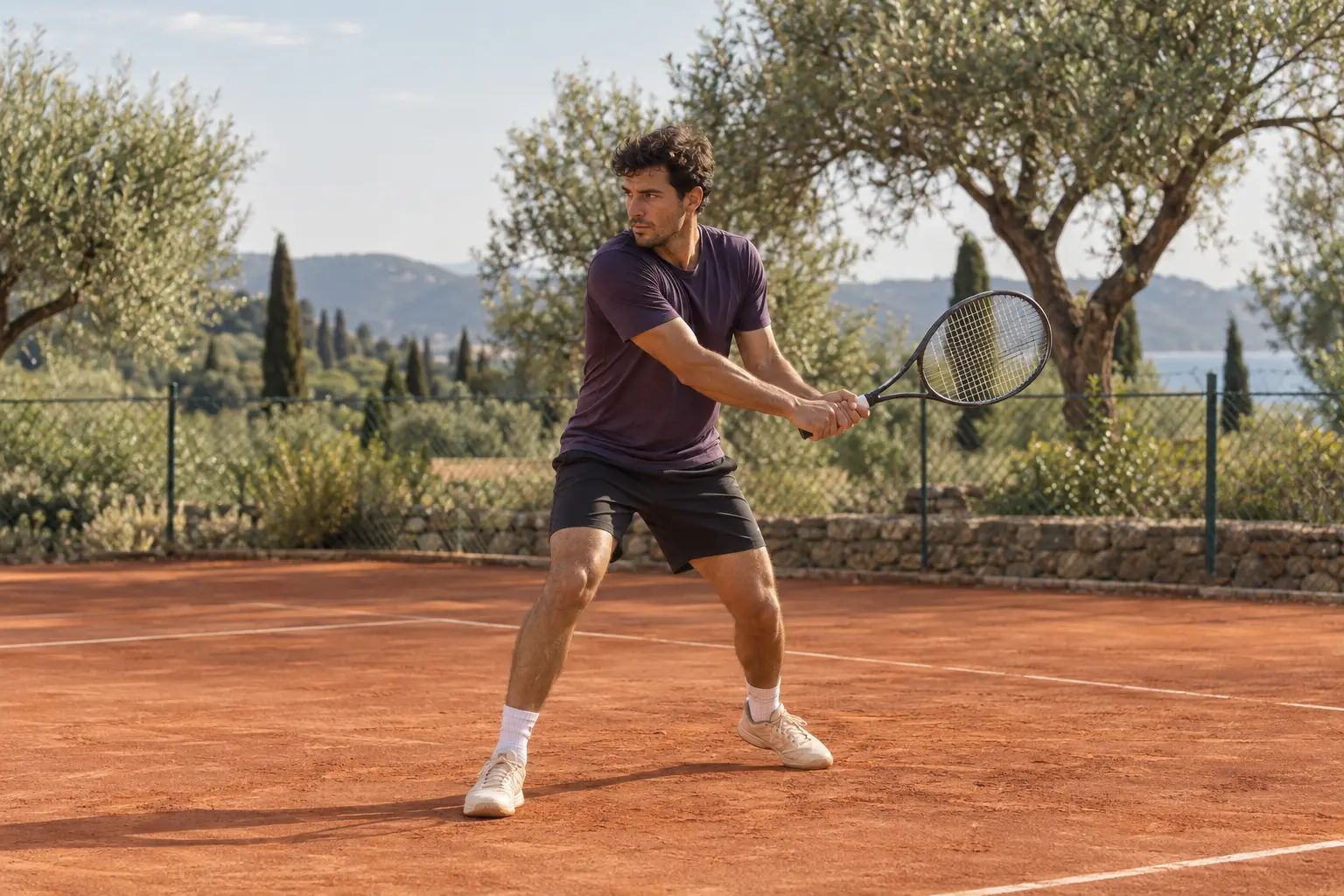
Prepare your workout
- Equipment
- Full court, Two rackets, 18 balls, Flat markers and Partner or coach
- Before you choose
- You should rally with control, know a basic serve and brake sideways. A feeder helps maintain a steady pace.
- Intensity
- Effort 4–6/10. Land four of six balls in a broad target before making it smaller.
- Warm-up
- Before the session, complete one gentle round of the three listed movements. Allow about 6 minutes for preparation, transitions and rehearsing the first exercise; extend this if needed. Rehearse the first exercise with light resistance before its sets, keeping breathing comfortable.
Duration is approximate. Prepare your equipment and take the indicated rests; needing more rest can make the workout longer.
PREPARE TO MOVEYour warm-up
Start with this gentle preparation before your working sets. The listed duration includes the warm-up.
Knee-raise march
60–90 s at a comfortable pace
Stand in a clear area to march on the spot or move slowly forward. Raise one knee comfortably, coordinating the opposite arm. Place the foot down with control and alternate in a steady rhythm.
What you train: Trains arm-leg coordination and balance while raising each knee.
Watch video ↗Controlled lateral movement
2 short walking lengths, stopping with control
Stand on level ground with clear space on both sides. Take short, controlled sideways steps without crossing your feet. Brake to a steady stop, then change direction.
What you train: Trains sideways movement, braking and foot placement.
Watch video ↗Bodyweight squat
1 × 6 gentle repetitions
Stand with your feet comfortably apart. Bend your hips and knees with weight shared between both feet. Push through the floor and straighten your legs to stand.
What you train: Strengthens legs and glutes and trains hip-knee coordination when lowering.
Watch video ↗
STEP BY STEP
Your complete workout
9 exercises01Two-handed backhand: engage the top hand
2 × (3 strokes with the top hand + 3 backhands)
How to do it- Place your non-dominant hand at the top of the grip and receive gentle feeds.
- Hit three gentle forehands with that hand to feel its contribution.
- Add the other hand and hit three comfortable two-handed backhands.
What it trainsTrains the upper hand's contribution and two-hand coordination.
- Rest
- Rest 30 s between sets. Collect the balls before the next block.
- Tempo
- Technical control; full pause between repetitions
The movement, step by step
With your non-dominant hand at the top of the grip, hit three gentle forehands on that side. Add the other hand and hit three two-handed backhands. Repeat to feel the top hand's contribution.
Technique cueThe top hand is left for right-handers and right for left-handers.
Variations and mistakes to avoid
- More accessible
- Slowly rehearse without a ball before receiving an easy feed.
- To progress
- Alternate strokes towards a broad zone at a comfortable pace.
- Avoid this mistake
- Pulling only with the lower hand and blocking the upper hand's contribution.
02Forehand preparation with a unit turn
2 × 6 forehands from gentle feeds
How to do it- Face a partner with racket clearance and ask for a gentle, predictable feed.
- Turn your trunk to prepare, initially catching with your non-dominant hand.
- Once the turn is controlled, repeat and hit a gentle forehand.
What it trainsTrains coordinated body and racket preparation for the forehand.
- Rest
- Rest 30 s between sets. Collect the balls before the next block.
- Tempo
- Technical control; full pause between repetitions
The movement, step by step
Your partner sends a gentle ball. Turn to prepare the forehand and first catch it with your non-dominant hand. Once you control the turn, repeat the feed and hit a gentle forehand.
Technique cuePrepare body and racket together before adding speed.
Variations and mistakes to avoid
- More accessible
- Use hand feeds and catch without hitting.
- To progress
- Aim the shot at a large target area after the bounce.
- Avoid this mistake
- Taking only the racket back without preparing the body.
03Feel topspin beside the net
2 × 6 attempts
How to do it- Gently hold a ball between the racket strings and the net's top tape.
- Brush the racket upward with a short movement, without pressing or striking the tape.
- Let the ball pass over and observe its forward spin.
What it trainsTrains the brushing direction that creates topspin.
- Rest
- Rest 30 s between sets. Collect the balls before the next block.
- Tempo
- Technical control; full pause between repetitions
The movement, step by step
Gently place the ball between the net tape and strings. Move the racket upwards to release the ball over the net and observe its forward spin.
Technique cueBrush gently without loading your weight against the net.
Variations and mistakes to avoid
- More accessible
- Slow down and reposition the ball after each attempt.
- To progress
- Then try the same movement with a gentle feed and one bounce.
- Avoid this mistake
- Pressing on the net or striking abruptly.
04Cooperative mini-tennis
3 × 60 s
How to do it- Stand near service lines on opposite sides of the net with the boxes clear.
- Start gently and return after one bounce inside the service boxes.
- Maintain a cooperative rally and adjust distance if control is lost.
What it trainsTrains force control and placement in a short cooperative rally.
- Rest
- Rest 30 s between sets. Collect the balls before the next block.
- Tempo
- Technical control; full pause between repetitions
The movement, step by step
Stand near the service lines. Begin with a gentle feed and maintain a rally after one bounce within the service boxes. Adjust the distance to preserve control.
Technique cueWork together to keep the ball in play.
Variations and mistakes to avoid
- More accessible
- Use a low-compression ball and catch after the bounce before returning it.
- To progress
- Alternate forehand and backhand without greatly increasing speed.
- Avoid this mistake
- Trying to hit a winner when the goal is cooperation.
05Baseline coverage and recovery
6 × 4 balls
How to do it- Start at a central baseline marker; your partner prepares reachable side feeds.
- Move to each ball, adjust final steps and hit in balance.
- Recover to centre before the next feed, leaving braking room.
What it trainsTrains lateral baseline coverage and recovery after hitting.
- Rest
- Rest 45 s between sets. Collect the balls before the next block.
- Tempo
- Moderate cadence; be ready for the next feed
The movement, step by step
Respond to sideways feeds from the baseline and recover to a central reference after each shot.
Technique cueThe feeder waits until you are ready; slow down if you arrive late.
Variations and mistakes to avoid
- More accessible
- Reduce feed width and speed.
- To progress
- Maintain accuracy with slightly faster feeds.
- Avoid this mistake
- Continuing when you are consistently late.
06Repeatable serve toss
2 × 6 throws
How to do it- Take your serving stance, ball in your non-dominant hand and landing area clear.
- Toss from a repeatable release point without throwing your body back.
- Watch where it lands; leave awkward tosses and reset.
What it trainsTrains a repeatable toss before serve contact.
- Rest
- Rest 30 s between sets. Collect the balls before the next block.
- Tempo
- Technical control; full pause between repetitions
The movement, step by step
From your serving position, toss the ball with your non-dominant hand and repeat a consistent release point. Observe where it would land without chasing it or hitting a toss that forces you to arch.
Technique cueUse a landing reference suited to your serve; do not chase a poor toss.
Variations and mistakes to avoid
- More accessible
- Practise only the toss, without a racket.
- To progress
- Add a comfortable serve once you can repeat a stable ball path.
- Avoid this mistake
- Compensating for a poor toss by straining your back or shoulder.
07Consecutive target serves
2 × 6 serves to a large target
How to do it- Mark a broad service-box target away from your footing and prepare normally.
- Serve towards it and record hits and consecutive successes.
- Reset after each attempt; alternate sides without adding to the prescribed total.
What it trainsTrains serve placement and a consistent concentration routine.
- Rest
- Allow 15–20 s between serves and 60 s between sets.
- Tempo
- Technical control; full pause between repetitions
The movement, step by step
Choose a service-box zone and seek consecutive successes with your usual routine. Count successes and the streak. Reset after each attempt and prepare the next serve.
Technique cueRepeat the same preparation after both successes and misses.
Variations and mistakes to avoid
- More accessible
- Use the whole service box as the target at a comfortable speed.
- To progress
- Narrow the target or alternate destinations while retaining the total number of serves.
- Avoid this mistake
- Adding unlimited serves to compensate for misses.
08Dynamic court warm-up
Additional exercise
1 × 5
How to do it- In a clear lane, begin walking and progress to a gentle jog.
- Add sideways steps and comfortable shoulder and hip movements.
- Finish with two short, gradual accelerations; walk back between them.
What it trainsPrepares court movement and coordinates legs, trunk and arms.
- Rest
- Rest 30 s or longer until control returns.
- Tempo
- Controlled, without holding your breath
The movement, step by step
Begin walking and move into an easy jog. Add sideways movement, comfortable shoulder and hip mobility, and two short progressive accelerations. Walk back between runs.
Technique cueThe final pass should leave you ready to play rather than exhausted.
Variations and mistakes to avoid
- More accessible
- Walk and reduce range and speed.
- To progress
- Add a controlled diagonal start before beginning to hit.
- Avoid this mistake
- Starting with a maximal run before warming up.
09Forehand self-rally with a bounce
Additional exercise
1 × 5
How to do it- In a clear space, face the racket upward with the ball on the strings.
- Tap to about eye height, allow one bounce and catch.
- Once controlled, link forehand taps with one bounce between each.
What it trainsTrains bounce judgement and racket-face control on the forehand.
- Rest
- Rest 30 s or longer until control returns.
- Tempo
- Controlled, without holding your breath
The movement, step by step
With the racket face upwards, tap the ball to approximately eye height. Allow one bounce and catch it. Then link taps with a bounce between each.
Technique cueUse a low-compression ball and a repeatable height.
Variations and mistakes to avoid
- More accessible
- Catch the ball after each bounce.
- To progress
- Link six contacts without leaving a marked area.
- Avoid this mistake
- Avoid hitting so hard that you must chase the ball.
FINISH THE SESSIONFinish and prepare your next step.
Walk for 2 min and record successful shots per set. Also record whether you recovered a useful position after hitting.
How to progress
First improve your success rate. Then change only target, width or cadence; keep the total number of balls.
Open workout in the app →General routines for adults. If you have a health condition, an injury, are pregnant or have medical instructions, consult your professional before starting and ask for adaptations. Stop if you experience pain, dizziness or unusual breathlessness.