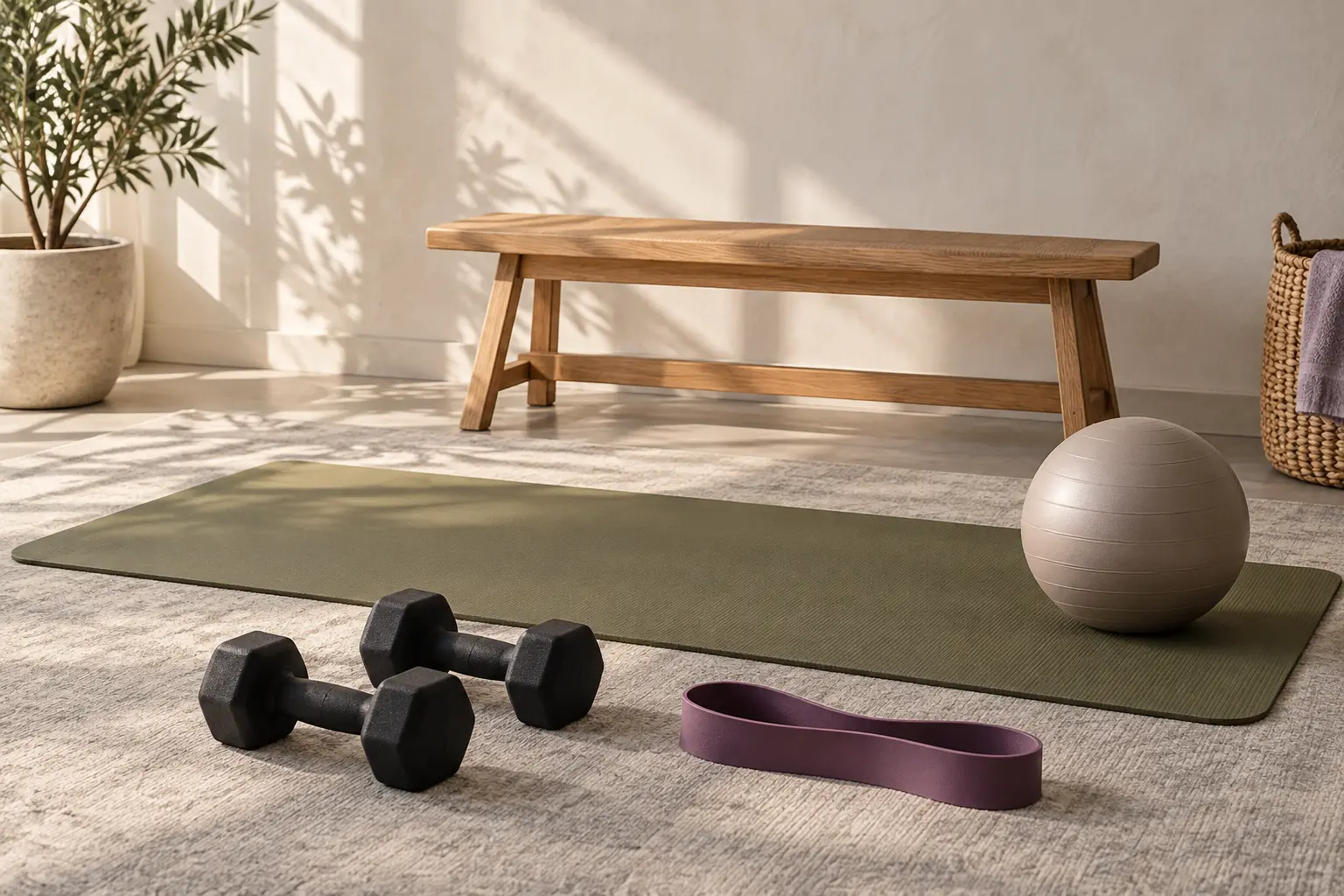
Prepare your workout
- Equipment
- Light dumbbells, Resistance band, Chair and Exercise mat; Clear gym space
- Before you choose
- General option for adults. Check each exercise's equipment and avoid improvised supports.
- Intensity
- Comfortable load with about 3 reps in reserve. You need not complete every set if technique worsens or you become tired.
- Warm-up
- Before the session, complete one gentle round of the three listed movements. Allow about 6 minutes for preparation, transitions and rehearsing the first exercise; extend this if needed. Rehearse the first exercise with light resistance before its sets, keeping breathing comfortable.
Duration is approximate. Prepare your equipment and take the indicated rests; needing more rest can make the workout longer.
PREPARE TO MOVEYour warm-up
Start with this gentle preparation before your working sets. The listed duration includes the warm-up.
Active walking
60–90 s at a comfortable pace
Choose a clear, safe area and start walking at a comfortable pace. Take regular steps with your arms moving naturally. Keep a pace that allows conversation and slow down to finish.
What you train: Warms up the body and trains arm-leg coordination while walking.
Watch video ↗Seated shoulder-blade squeeze
1 × 6 gentle repetitions
Sit with feet grounded, arms relaxed and shoulders away from ears. Gently bring shoulder blades together without arching or lifting your chest. Hold three seconds, then fully relax.
What you train: Practises drawing shoulder blades together with relaxed neck and shoulders.
Watch video ↗Seated thoracic rotation
1 × 5 gentle repetitions per side
Sit upright with feet grounded and arms crossed over your chest. Gently rotate your chest to one side without moving your pelvis. Return to the centre with control and turn the other way.
What you train: Trains upper-back mobility from a stable seated position.
Watch video ↗
STEP BY STEP
Your complete workout
10 exercises01Shoulder circles
Additional exercise
1 × 6
How to do it- Sit or stand with your arms relaxed at your sides.
- Make small, slow shoulder circles backwards.
- Reverse direction, then let your shoulders relax.
What it trainsGently mobilises the shoulders and shoulder blades before activity.
- Rest
- Rest 45 s or longer until control returns.
- Tempo
- Controlled, without holding your breath
- Effort reserve
- RIR 3: finish with about 3 repetitions you could still perform with good technique.
The movement, step by step
Sitting or standing, let your arms relax. Make small, slow circles with your shoulders backwards, then forwards.
Technique cueKeep your head still and breathe naturally.
Variations and mistakes to avoid
- More accessible
- Make smaller circles.
- To progress
- Make the circles larger only within a comfortable range of movement.
- Avoid this mistake
- Moving abruptly or tensing your neck.
02Unloaded neck mobility
Additional exercise
1 × 6
How to do it- Sit or stand, shoulders relaxed, looking forward with chin at a natural height.
- Slowly turn your head comfortably to one side without moving your trunk.
- Return to centre and turn the other way without circling.
What it trainsTrains controlled neck rotation within a comfortable range.
- Rest
- Rest 45 s or longer until control returns.
- Tempo
- Controlled, without holding your breath
- Effort reserve
- RIR 3: finish with about 3 repetitions you could still perform with good technique.
The movement, step by step
Relax shoulders and slowly turn your head right and left within a comfortable range, returning to centre between repetitions.
Technique cueKeep chin height constant without seeking maximum range.
Variations and mistakes to avoid
- More accessible
- Reduce resistance and range; keep the movement comfortable and controlled.
- To progress
- Once you complete the prescribed amount with control, add one or two repetitions; then slightly increase resistance.
- Avoid this mistake
- Making full head circles or forcing the end range.
03Light-weight shoulder shrug
Train
2 × 8
How to do it- Stand holding light weights at your sides, head aligned and eyes forward.
- Gently raise both shoulders without bending elbows or moving your head.
- Lower slowly to relax, without circling.
What it trainsWorks the trapezius while raising and lowering lightly loaded shoulders.
- Rest
- Rest 45 s or longer until control returns.
- Tempo
- Controlled, without holding your breath
- Effort reserve
- RIR 3: finish with about 3 repetitions you could still perform with good technique.
The movement, step by step
With arms at your sides, gently raise both shoulders and lower slowly without circling.
Technique cueMove shoulders vertically and keep your neck still.
Variations and mistakes to avoid
- More accessible
- Reduce resistance and range; keep the movement comfortable and controlled.
- To progress
- Once you complete the prescribed amount with control, add one or two repetitions; then slightly increase resistance.
- Avoid this mistake
- Circling your shoulders or extending your neck.
How to do it- Lie face down with forehead supported and arms in a Y, thumbs up.
- Lift arms a few centimetres without raising your chest or head.
- Slowly lower your hands and repeat the same short range.
What it trainsTrains shoulder and shoulder-blade control in an overhead position.
- Rest
- Rest 45 s or longer until control returns.
- Tempo
- Controlled, without holding your breath
- Effort reserve
- RIR 3: finish with about 3 repetitions you could still perform with good technique.
The movement, step by step
Lie face down with forehead supported and arms in a Y, thumbs up. Slightly lift arms without raising your chest, then lower with control.
Technique cueKeep shoulders away from ears; a slight hand lift is enough.
Variations and mistakes to avoid
- More accessible
- Reduce resistance and range; keep the movement comfortable and controlled.
- To progress
- Once you complete the prescribed amount with control, add one or two repetitions; then slightly increase resistance.
- Avoid this mistake
- Lower-back arching or neck tension.
05Supported rear-delt raise
Train
2 × 8
How to do it- Rest one hand on a table, hinge forward and hold a light dumbbell in the other.
- Open the loaded arm sideways, elbow slightly bent, without rotating your chest.
- Lower slowly with your back still.
What it trainsWorks the rear shoulder with additional trunk support.
- Rest
- Rest 45 s or longer until control returns.
- Tempo
- Controlled, without holding your breath
- Effort reserve
- RIR 3: finish with about 3 repetitions you could still perform with good technique.
The movement, step by step
Rest one hand on a firm table and hinge forward from your hips. Open the other arm sideways with a slightly bent elbow, then return slowly.
Technique cueUse a short range; move the shoulder while the trunk stays still.
Variations and mistakes to avoid
- More accessible
- Reduce resistance and range; keep the movement comfortable and controlled.
- To progress
- Once you complete the prescribed amount with control, add one or two repetitions; then slightly increase resistance.
- Avoid this mistake
- Moving your back to open the arm.
06Band pull-apart
Train
2 × 8
How to do it- Hold a light band in front of your chest, elbows slightly bent.
- Move your hands apart through a comfortable shoulder range.
- Slowly bring your hands together, controlling the band's tension.
What it trainsStrengthens the rear shoulders and trains shoulder-blade movement.
- Rest
- Rest 45 s or longer until control returns.
- Tempo
- Controlled, without holding your breath
- Effort reserve
- RIR 3: finish with about 3 repetitions you could still perform with good technique.
The movement, step by step
Hold a light band in front of your chest with your elbows slightly bent. Pull your hands apart through a comfortable range, then return.
Technique cueKeep your shoulders away from your ears and your trunk still.
Variations and mistakes to avoid
- More accessible
- Use a lighter band or a smaller range of movement.
- To progress
- Add a brief pause with your arms apart.
- Avoid this mistake
- Forcing your shoulders beyond their comfortable range.
07Wall arm slide
Additional exercise
1 × 6
How to do it- Face a wall with hands or forearms resting at a comfortable height.
- Slide your arms upward without arching your back or straining your shoulders.
- Slide back down with control.
What it trainsTrains coordinated shoulder and shoulder-blade movement while raising the arms.
- Rest
- Rest 45 s or longer until control returns.
- Tempo
- Controlled, without holding your breath
- Effort reserve
- RIR 3: finish with about 3 repetitions you could still perform with good technique.
The movement, step by step
Stand facing a wall and rest your hands or forearms on it at a comfortable height. Gently slide them upwards and back down without forcing your shoulders.
Technique cueKeep ribs above your pelvis; you do not need to reach the highest point.
Variations and mistakes to avoid
- More accessible
- Reduce the height of the slide.
- To progress
- Gradually increase the range of movement if you can maintain your posture.
- Avoid this mistake
- Arching your back to reach higher or pushing through discomfort.
08Prone T raise
Additional exercise
1 × 6
How to do it- Lie face down with forehead supported and arms in a T, thumbs up.
- Lift arms a few centimetres without raising your head or shrugging.
- Lower slowly with control.
What it trainsStrengthens rear shoulders and trains shoulder-blade control with open arms.
- Rest
- Rest 45 s or longer until control returns.
- Tempo
- Controlled, without holding your breath
- Effort reserve
- RIR 3: finish with about 3 repetitions you could still perform with good technique.
The movement, step by step
Lie face down, forehead supported, arms in a T and thumbs up. Raise arms a few centimetres and lower slowly.
Technique cueUse a small range in which you feel shoulder-blade movement.
Variations and mistakes to avoid
- More accessible
- Reduce resistance and range; keep the movement comfortable and controlled.
- To progress
- Once you complete the prescribed amount with control, add one or two repetitions; then slightly increase resistance.
- Avoid this mistake
- Forcing height or extending your neck.
09Calm standing breathing
Additional exercise
1 × 6
How to do it- Stand with feet firm, knees relaxed and shoulders down.
- Breathe in comfortably without shrugging or maximally filling your lungs.
- Exhale slowly and repeat the cycles in your session.
What it trainsPractises calm standing breathing and awareness of chest and rib movement.
- Rest
- Rest 45 s or longer until control returns.
- Tempo
- Controlled, without holding your breath
- Effort reserve
- RIR 3: finish with about 3 repetitions you could still perform with good technique.
The movement, step by step
With feet firm and knees relaxed, inhale without shrugging and exhale slowly. Complete five comfortable cycles.
Technique cueUse a natural rhythm without forcing air in or out.
Variations and mistakes to avoid
- More accessible
- Reduce resistance and range; keep the movement comfortable and controlled.
- To progress
- Once you complete the prescribed amount with control, add one or two repetitions; then slightly increase resistance.
- Avoid this mistake
- Becoming dizzy through breathing too fast.
10Unloaded arm opening
Additional exercise
1 × 6
How to do it- Sit or stand with your arms in front at a comfortable height.
- Gently open them sideways without moving your trunk.
- Slowly bring your arms back together in front.
What it trainsTrains shoulder movement and arm coordination without added load.
- Rest
- Rest 45 s or longer until control returns.
- Tempo
- Controlled, without holding your breath
- Effort reserve
- RIR 3: finish with about 3 repetitions you could still perform with good technique.
The movement, step by step
Sitting or standing, gently open your arms at a comfortable height, then bring them back together in front. Keep your shoulders relaxed and torso stable.
Technique cueRelax your shoulders; your hands do not need to go behind your body.
Variations and mistakes to avoid
- More accessible
- Keep your arms below shoulder height.
- To progress
- Add a short pause as you open your arms without arching your back.
- Avoid this mistake
- Forcing your shoulder range or pushing your chest out too far.
FINISH THE SESSIONFinish and prepare your next step.
Walk slowly and breathe comfortably for 2–3 minutes. Allow at least one recovery day before repeating hard strength work for the same muscle group.
Open workout in the app →General routines for adults. If you have a health condition, an injury, are pregnant or have medical instructions, consult your professional before starting and ask for adaptations. Stop if you experience pain, dizziness or unusual breathlessness.